Product Lead, B2B SaaS, 2025
Brücke
From concept to MVP in eight weeks.
Brücke was built from scratch. There was a concept and nothing else: no design and no defined user. I worked from the user: strategy first, then structure, then every screen. Eight weeks later the MVP was done, and the founders raised a pre-seed round on it.
- Client
- Brücke, via Wandr Studio
- Role
- Product Lead, 0 → MVP
- Team
- 2 product designers
- Scope
- Product strategy, UX research, MVP scope
- Timeline
- 8 weeks, 2025
- Pre-seedRound raised on the MVPThe MVP was what the founders pitched with, and Brücke raised on it. The product was one part of that pitch, so I do not attribute the round to it alone.
- 20Research participantsMarketers and heads of marketing who would launch their campaigns on the platform, chosen for the reports they needed from it.
- 01Iteration roundThe research was focused enough that one round was all it took.
I wrote the pitch deck, and every claim in it traced back to something one of the 20 research participants had actually said.
Overview
Brands collect customer data they have no way to act on.
Brücke is a brand intelligence platform for the Spanish-speaking market, built to close the gap between what brands collect and what they actually understand. It turns first-party data into action, connecting physical and digital touchpoints through WhatsApp, SMS, web chat and Messenger.
First-party data: collected directly from brand interactions, not bought or rented. Phygital integration: what happens in-store connects to what happens online. Conversational channels: campaigns that reach people where they already are, in the language of conversation.
Where it started
A blank page.
When I joined Brücke, nothing existed yet. No product, no design, no defined user. There was a concept, a brand intelligence platform that could turn first-party data into action. My job was to turn that concept into a product someone could actually use.
That meant figuring out who it was for before designing anything. Every decision about structure, flow and interface came after that answer.
Didn't exist
- Data tables without context
- No campaign creation path
- Navigation by system logic
- Raw metrics, no interpretation
- No onboarding or guidance
What we built
- Insights at a glance
- One clear path to create
- Navigation by user goal
- Metrics with an interpretation
- AI guidance at every step
Everything in the right-hand column was built in those eight weeks.
Research first
Before designing anything, I needed to know who this was for.
And what would make a dense product feel simple to them. Twenty participants, all marketers and heads of marketing who would launch campaigns on Brücke, chosen for the reports they needed from it. Interviews and concept testing, plus one full round of iteration, before any screen was committed to.
Skipping research would have cost more time than doing it. One structured round set the product direction before it could drift. Two findings came out of it: users struggled most with campaign creation and responded most strongly to connecting in-store and online data. Both went into the structure; the in-store integration itself waited for the roadmap.
I expected the main challenge to be fitting everything in. It turned out to be the first thirty seconds of use. The architecture was built around one question, asked on every screen: what does this person need to do right now?
A marketing director opening a powerful new tool needed to know what to do first. The product's job was to close the distance between data and decision.
The work
Scoping the MVP to eight weeks.
Five core areas defined the structure. The campaign flow was built around AI at every decision point, as part of the architecture from the start.
The founders wanted everything they had in mind in the first version, and reducing that to what eight weeks could deliver was the hardest part of the work. The research is what settled it: we could show which features users needed and which could wait, so the cuts came from evidence rather than opinion.
I split the work between the two designers by flow, then sequenced it by dependencies.
-
Product strategy
Decided what Brücke would and wouldn't do before any screen existed. The cut rule: if it didn't make the product more valuable to its users or more convincing to its investors, it waited. So the MVP shipped with one channel, WhatsApp, and held SMS, web chat, Messenger and the in-store integration for the roadmap.
-
Structure
Five core areas: Dashboard, Campaigns, Audiences, Surveys and Settings, structured around how a marketing director makes decisions rather than how the data is stored.
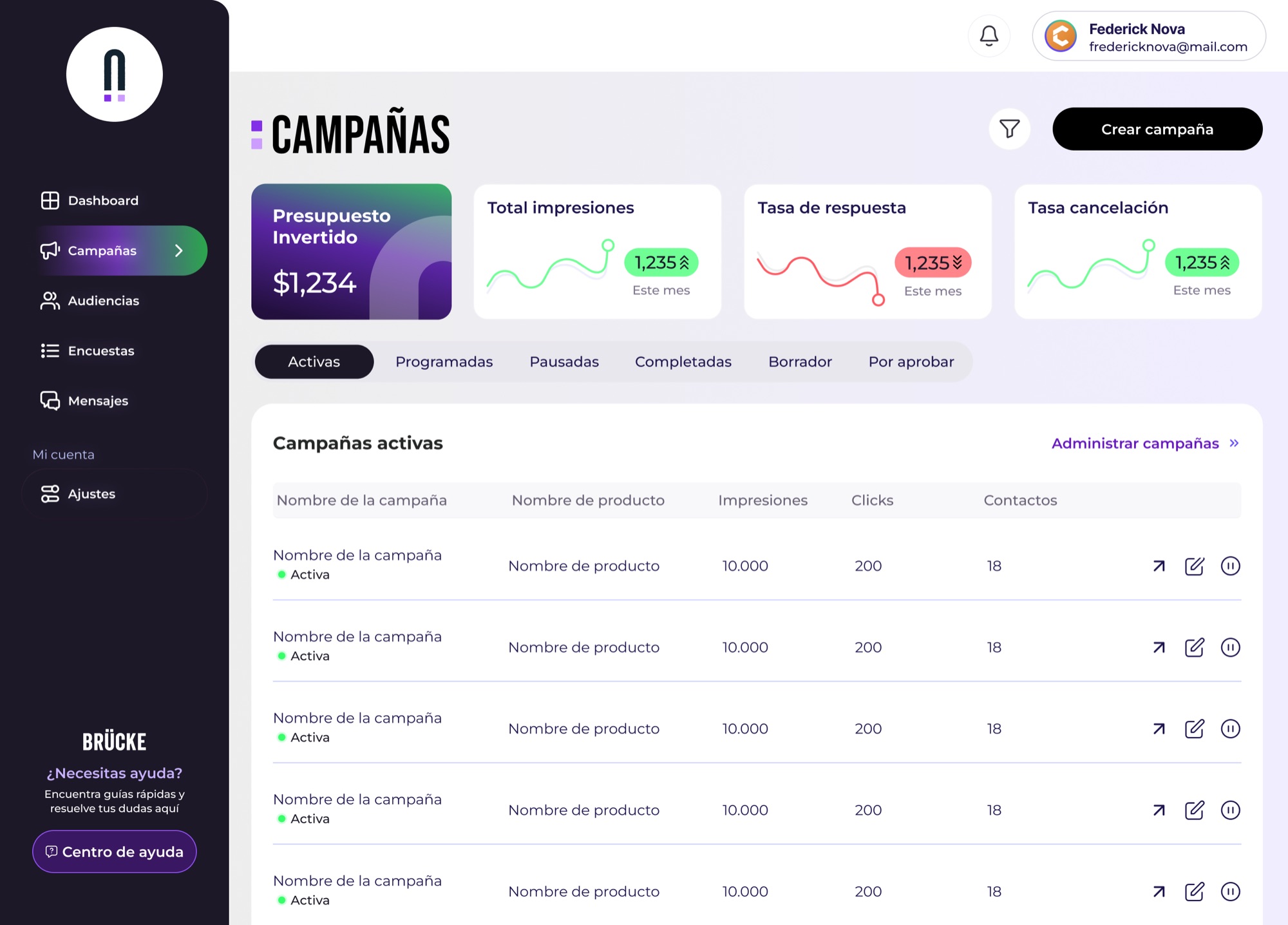
Campaigns: what a marketing director needs first sits on top -
Campaign flow
A 7-step creation flow with AI present at each decision point, recommending, optimising and adapting without taking over.
-
Look and feel
Built for two tensions: data-dense views that stay readable, and emotional insight that still reads as human.
The tension
A marketing director had to read layered data at a glance, without a training session.
Brücke is a complex product. The data is layered, the campaign logic is conditional and the audience segmentation is granular. But the user, a marketing director with many competing priorities, needed it to feel simple.
We kept the features and built the hierarchy from the user's goal down: whatever a marketing director needs right now sits on top, and everything else steps back.
The second tension came with a hard constraint built into the one channel the MVP shipped with. WhatsApp's API is strict, and none of that strictness should ever reach the person building a campaign.
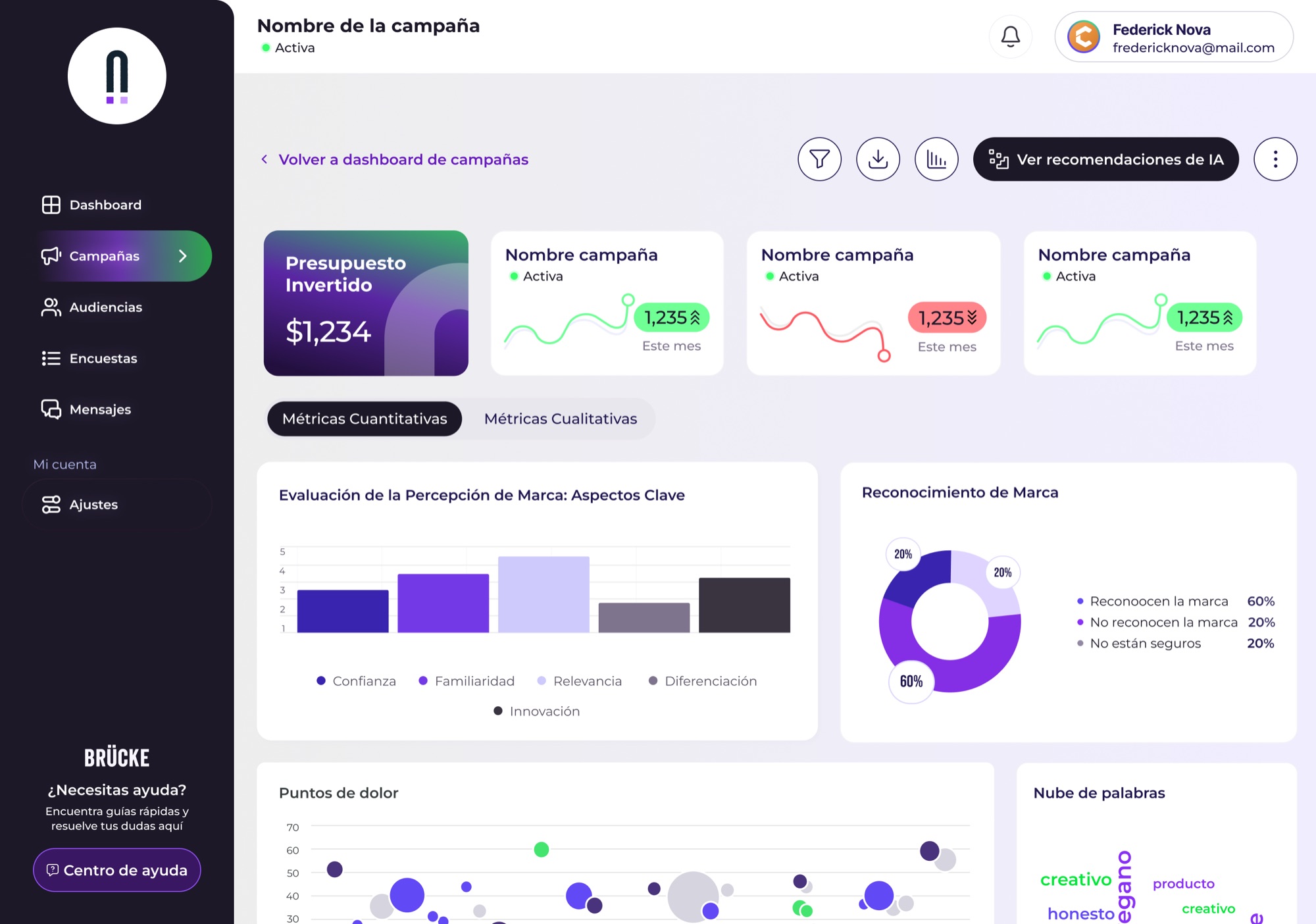
Conversational logic
Designing within the rules.
WhatsApp's API has hard constraints: message templates must be pre-approved, opt-in logic is mandatory, and delivery timing is tightly regulated. The design had to make these limits invisible to the user, hiding the compliance layer while keeping full control.
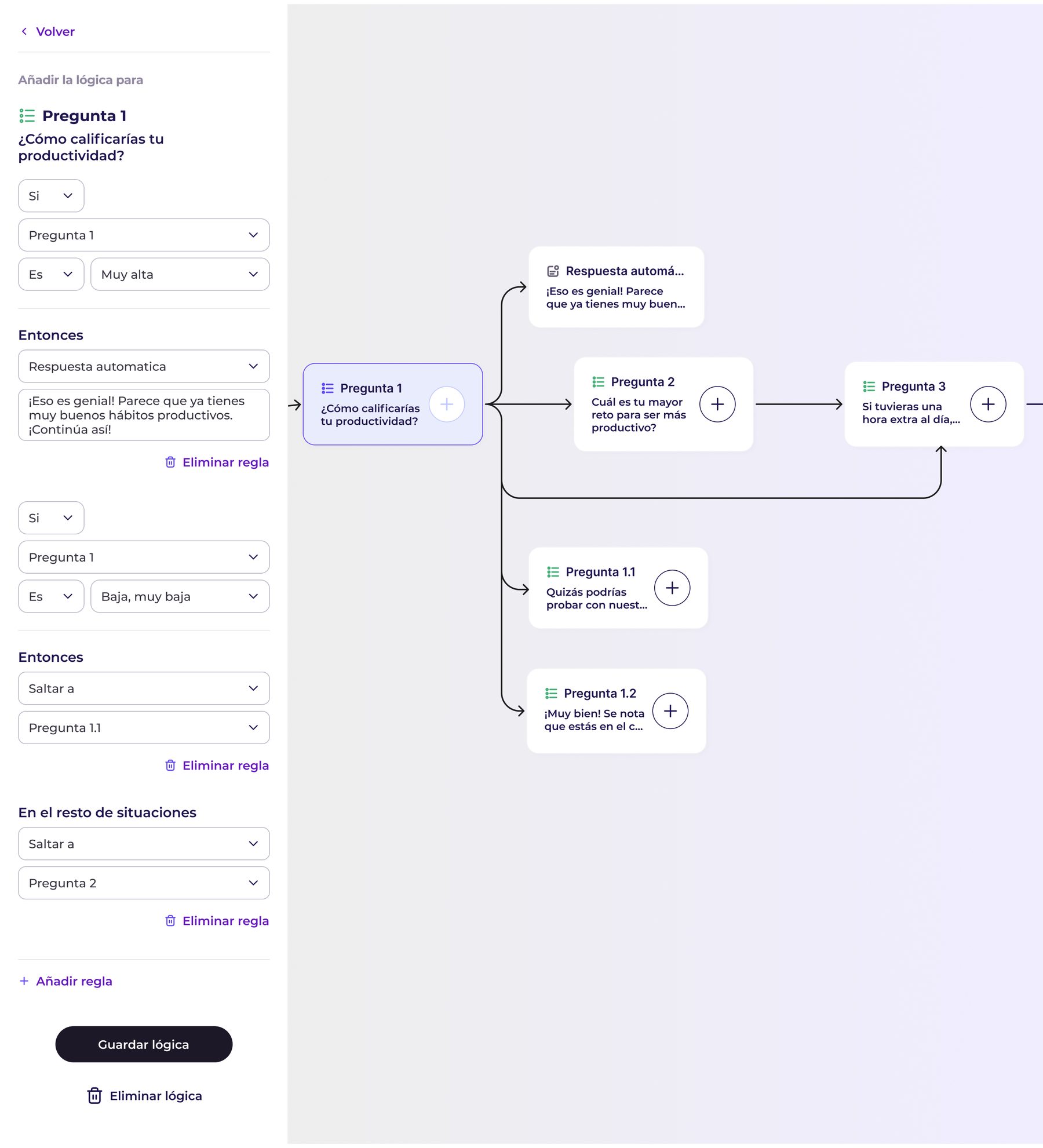
AI as structure
AI built into the campaign flow.
The campaign flow was designed around AI from the first step: recommending objectives, optimising timing, generating messages, adapting to responses.
Six of the seven steps have an AI layer beneath them. It's there because the people using Brücke don't want to spend an hour creating a campaign.
How do you let teams create personalised conversational campaigns simply, with AI present at every decision point rather than only at the end?
- 01Set up the campaignCreate with AI, have the Brücke team build it, or build manually and let AI refine. Describe the product, set the calendar.AI recommends optimal send times
- 02Objective and actionSales, engagement, leads, support or retargeting, and the action expected: purchase, subscription, demo.AI recommends objective, KPIs and CTA
- 03AudienceHigh value, new, abandoned cart, reactivation or custom. Data from CMS, Shopify, WordPress, HubSpot or a spreadsheet.AI recommends the segment
- 04Conversational channelWhatsApp, SMS, Messenger or web chat. WhatsApp Business connects by number, QR and authorisation.No AI step
- 05Flow and contentAuto Q&A, surveys, drip or lead scoring, in the brand's tone: formal, friendly, professional, close.AI generates the full script, editable, in tone
- 06Timing and alertsInstant, drip, daily or one-off, with alerts for low conversion, high bounce, negative replies and carts.AI optimises send timing
- 07Review and launchOne summary of everything before it goes live. Save as draft, send for review, or launch.AI recommends final optimisations
This is the flow as designed. The MVP shipped it on one channel, WhatsApp.
The product
A complex product that stays usable.
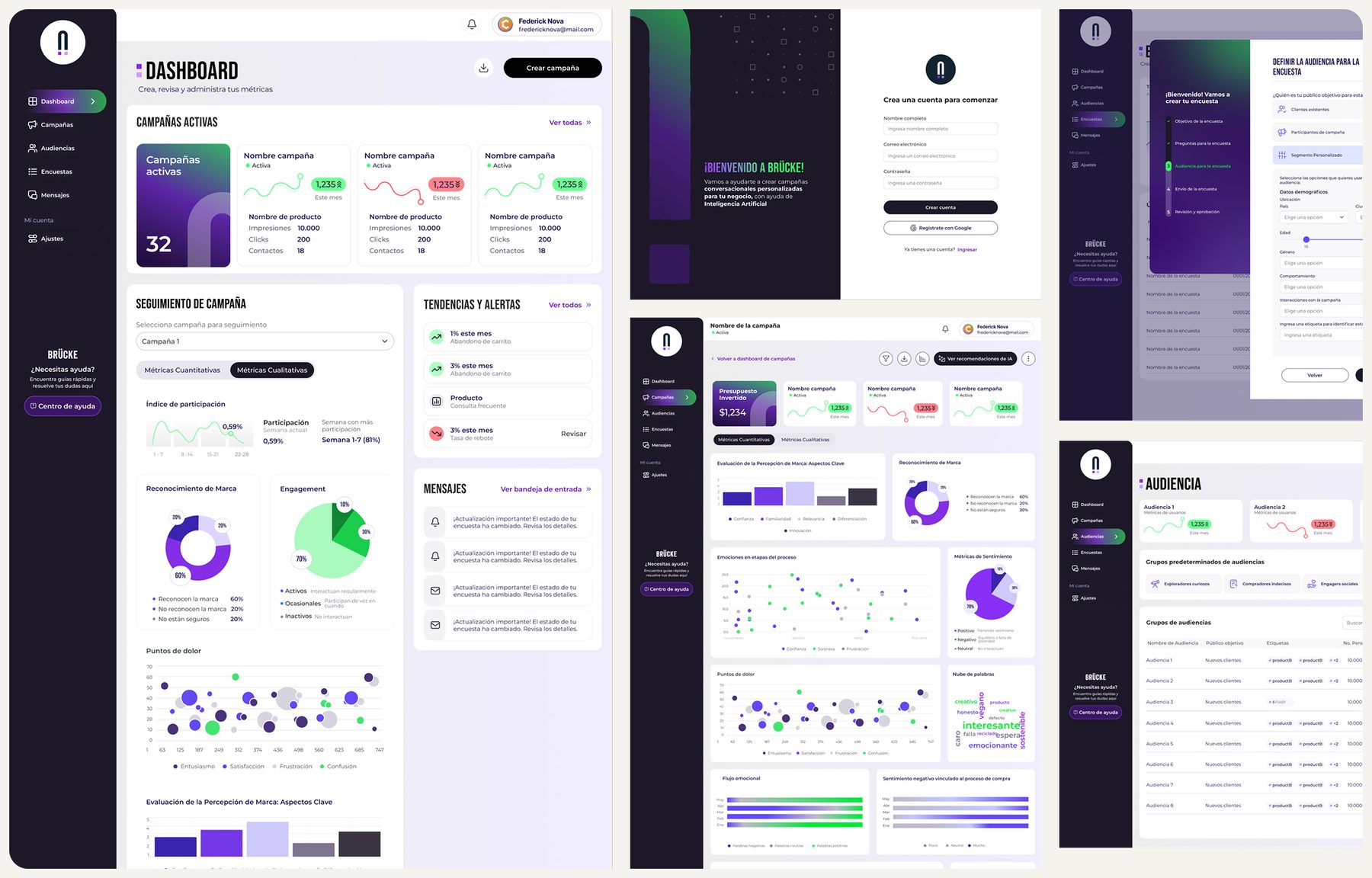
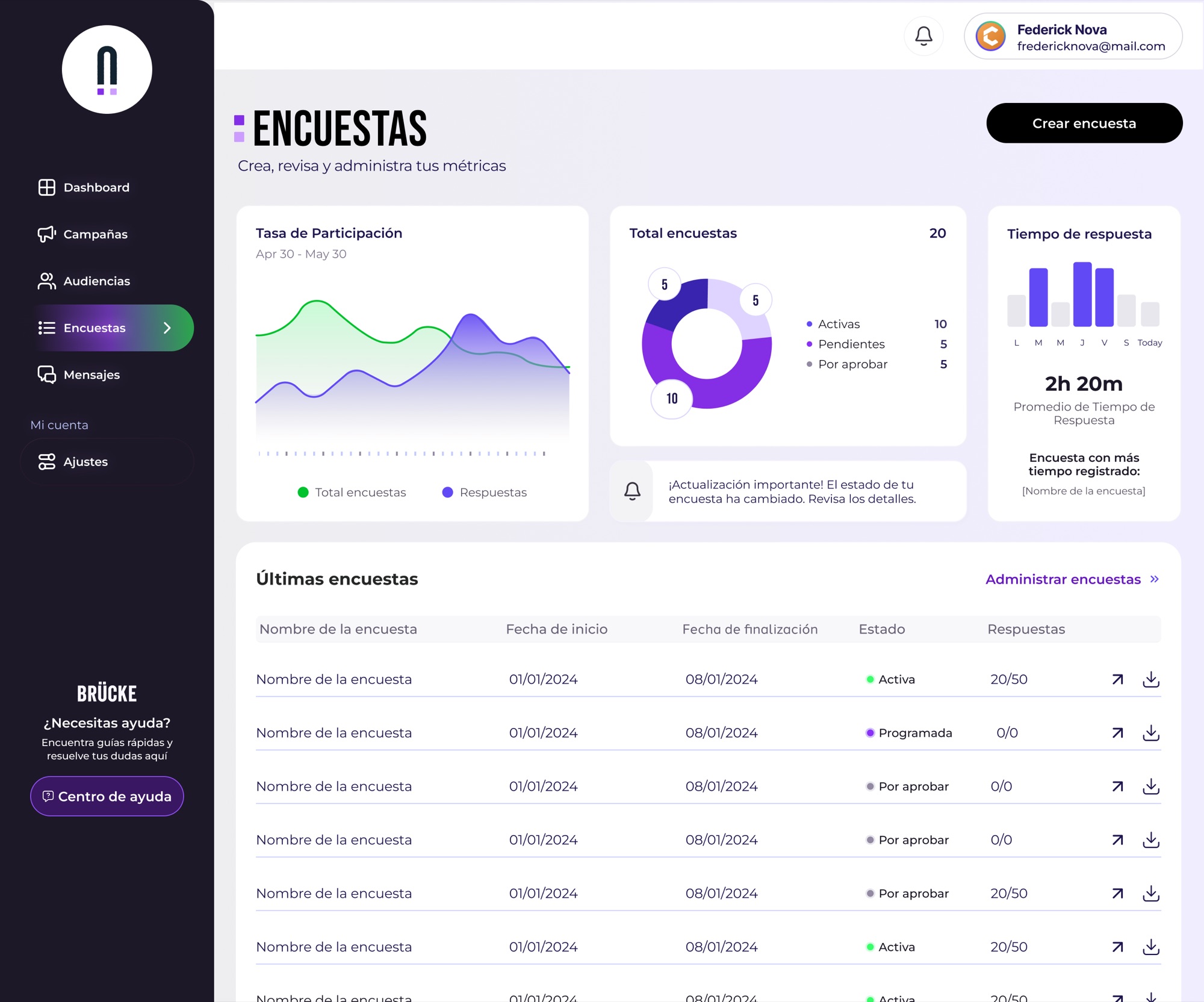
Campaign dashboards, audience segmentation, sentiment tracking and survey flows from the shipped MVP.
From the client
“Raquel took something that existed only in conversation and gave it structure, logic, and direction. She didn't just design screens, she defined what the product needed to be before anyone picked up a tool.”
Reflection
“Eight weeks was enough because the scope was defined before design began.”
Brücke raised a pre-seed round. The outcome I'm prouder of is that the product made sense to the people it was built for before it was pitched to investors. My part ended at the MVP. I was not involved after the round.
It also changed the conversations with engineering. They stopped being about why we were building something and started being about how.
What I would change: I would bring the developers into the room from the first week, with a tighter meeting cadence.